Call us Mon-Fri 7am-4pm

1300 199 480

Fill in the fields, we’ll contact you

Name(Required)
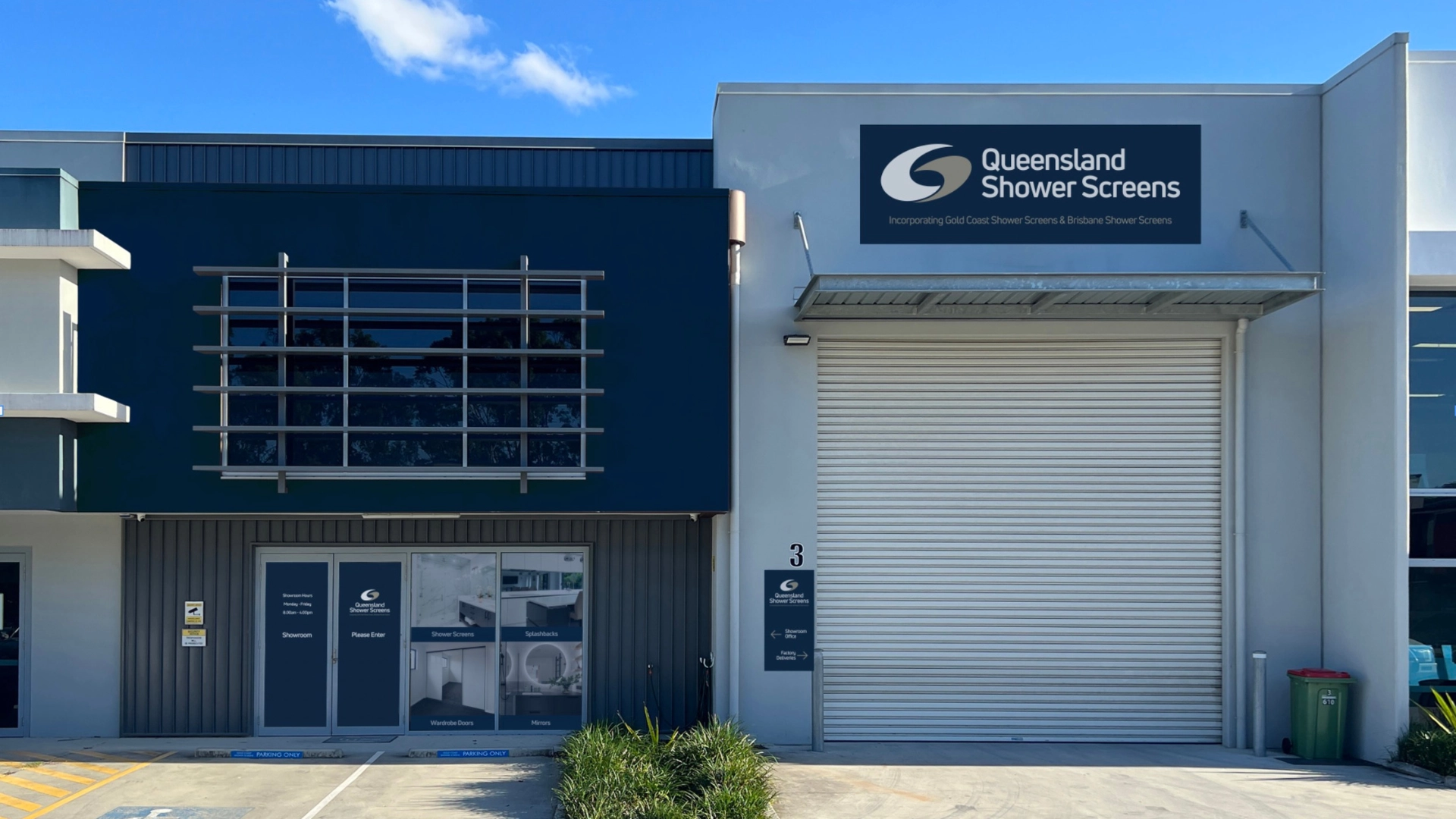
Queensland Shower Screens showroom and factory exterior, Gold Coast β€” incorporating Gold Coast Shower Screens and Brisbane Shower Screens

How to Choose Shower Screen Manufacturers on the Gold Coast

Shower screen manufactures on Gold Coast handle every stage: from the initial measure after tiling to custom glass sourced from certified manufacturers, delivery to site, professional installation, and final compliance sign-off. Gold Coast Shower Screens is one of those manufacturer-installers β€” and the service is fundamentally different from buying a screen through a retailer. Understanding that difference is the most practical thing you can do before engaging anyone to supply or install on the Gold Coast.

Here is how shower screen manufactures on Gold Coast work, what the service includes, how it compares to off-the-shelf supply, and what the full installation timeline looks like from measure to completion.


What Does a Shower Screen Manufacturer Do That a Retailer Doesn’t?

The difference between a shower screen manufacturer and a retailer is not a marketing distinction β€” it is a practical one that affects fit, compliance, and accountability.

A shower screen manufacturer on the Gold Coast:

  • Designs for your specific space β€” a manufacturer takes a measure of your finished bathroom opening and designs the screen around those exact dimensions. Wall plumb, floor fall, door clearance, obstacle positions β€” all factored in before a single piece of glass is cut.
  • Sources and processes glass to specification β€” glass is sourced from certified manufacturers and cut to the confirmed dimensions of your opening. This gives direct control over fit, edge finishing, and production timeline β€” with full accountability for the finished panel.
  • Installs what they supply β€” the team that supplied the screen is the team that installs it. If a panel needs adjustment, if a hinge position needs to be moved, or if site conditions on the day differ from the measure, the team can respond immediately. A retailer who has ordered pre-cut panels from a distributor and subcontracted installation to a separate glazier has no capacity to make that call.
  • Issues compliance certification β€” under Queensland building regulations, a Form 15 (design) and Form 16 (construction) compliance certificate must be issued by a QBCC-licensed supervising glazier. A manufacturer-installer issues both certificates as part of the single engagement. Split supply-and-installation arrangements frequently create gaps in who is responsible for compliance documentation.

A retailer, by contrast, sells screens from a catalogue. Panels arrive in standard sizes β€” typically 700mm, 800mm, 900mm, and 1,200mm width options β€” and the installer adapts the installation around the available dimensions rather than around your bathroom. In a new-build bathroom with a perfectly square opening and plumb walls, this sometimes works. In a real Gold Coast bathroom β€” particularly an older home or an apartment building where walls have settled, floors have a fall, and openings are rarely standard β€” it rarely produces a clean result.


What Is Included in a Supply and Install Service on the Gold Coast?

A complete supply and install service from a Gold Coast shower screen manufacturer covers every stage from initial contact to compliance sign-off. Here is what the service includes, in sequence:

1.  On-site measure β€” taken after tiling is fully complete. Measuring before tiles are laid produces an approximate dimension; the tiled surface is the finished surface the screen will seal against. Width is recorded at three heights (top, middle, base) to identify any taper in the opening. Wall plumb, floor fall, and the exact position of any obstructions β€” taps, niches, towel rails β€” are also recorded at this visit.

2.  Custom glass manufacture β€” glass panels are cut to the confirmed dimensions in the workshop. For semi-frameless screens: 6mm toughened safety glass, edged and polished. For frameless screens: 10mm toughened safety glass, processed to tighter tolerances. All glass is compliant with AS/NZS 2208.

3.  Hardware selection and confirmation β€” finish is confirmed at or before the measure appointment. Chrome, matte black, brushed nickel, or brushed gold for hinges, handles, and channel. Marine-grade stainless steel and powdercoated aluminium are specified for coastal Gold Coast locations as standard.

4.  Delivery to site β€” glass panels are transported to the installation address. For apartment buildings across Surfers Paradise, Broadbeach, and Robina, delivery logistics include lift booking, corridor clearance, and coordination with building management where required.

5.  Professional installation β€” carried out by QBCC-licensed glaziers. Wall fixings are drilled and anchored into confirmed solid backing. Panels are set plumb, doors are hung and adjusted for smooth, consistent operation. Semi-frameless screens are completed in a single visit. Frameless hinged-door screens require two visits β€” fixed panels first, then the door manufactured to the confirmed gap and fitted at the second visit.

6.  Silicone sealing β€” applied at all wall junctions and floor contacts in continuous runs with no voids. Curing time is 24 hours minimum before the shower is used. The silicone work on a shower screen is the primary waterproof barrier β€” it is not a finishing detail.

7.  Door alignment and function check β€” every door is tested through its full range of motion before the installation is signed off. Hinge angle, seal engagement along the door edge, and base sweep contact are all checked and adjusted on site.

8.  Compliance certification β€” Form 15 (design compliance) and Form 16 (construction compliance) are issued by the supervising QBCC-licensed glazier, confirming the installation meets AS 1288:2021 (Glass in Buildings) and AS/NZS 2208 (Safety Glazing Materials). These certificates are your legal record of a compliant installation.
Pro Tip: Ask to receive your Form 15 and Form 16 certificates in writing after installation β€” not just a verbal confirmation that the work is compliant. These documents are required for building inspections, property settlements, and insurance claims. A licensed installer who does not issue them in writing is not completing the job to the required standard.


How Does Custom Manufacture Differ From Off-the-Shelf Screens?

This is the question that most homeowners do not ask until they have already experienced the problem β€” a screen that doesn’t quite seal at one corner, a door that swings slightly off-plane, a gap between the glass and the wall tile that silicone alone cannot bridge cleanly.

Here is the practical difference:

Custom ManufactureOff-the-Shelf
DimensionsCut to the exact finished opening β€” accounts for taper, plumb, and floor fallFixed standard sizes β€” 700, 800, 900, 1,200mm width options
Wall toleranceDesigned around your actual wall conditionsAssumes a plumb, square, standard opening
Door alignmentDoor manufactured to confirmed installed gap β€” hangs square and seals evenlyDoor cut to a catalogue dimension β€” alignment depends on how well walls match the standard
ComplianceForm 15 and Form 16 issued by supervising licensed glazierCompliance certification not always available for standard-size retail product
AccountabilitySingle manufacturer-installer responsible for fit, function, and certificationSupplier and installer are separate β€” accountability gaps if fit or function is not right

The cost difference between custom shower screens gold coast and off-the-shelf options is often smaller than people expect β€” particularly once the cost of adapting a standard screen to a non-standard opening is accounted for. A screen that requires shimming, extra silicone to bridge gaps, or a second installation visit to correct a door alignment problem is not a cheaper screen. It is an incomplete job.


What Is the Installation Process From Measure to Completion on the Gold Coast?

This is the full sequence for a shower screen installation gold coast β€” from the first contact through to the compliance certificates being issued. The timeline and number of visits varies by screen type, but the steps are consistent.

Semi-Frameless Screens β€” Single Visit Installation

Semi-frameless shower screens are the most common installation type on the Gold Coast and are completed in a single installation visit after the measure. The sequence runs: enquiry and booking β†’ site measure after tiling β†’ glass manufacture (5–7 business days) β†’ installation visit β†’ silicone cure (24 hours) β†’ shower in use. Total elapsed time from measure to first use is typically 7–9 days.

Frameless Hinged-Door Screens β€” Two Visit Installation

Frameless shower screens require two installation visits. The first visit fits all fixed panels and structural elements β€” side panels, clamps, wall fixings, and any floor or ceiling pivots. Once these are set, the exact gap for the hinged door is measured with everything in place. The door is manufactured to this confirmed dimension β€” not to the original design drawing β€” and fitted at the second visit. This two-visit sequence is what makes frameless installation different from every other screen type, and it is not a shortcut that can be eliminated without compromising the result. Total elapsed time from first measure to first use is typically 12–16 days. For a full comparison of frameless and semi-frameless options, see our guide on frameless vs semi-frameless shower screens on the Gold Coast.

Framed Screens β€” Single Visit Installation

Framed shower screens follow the same single-visit sequence as semi-frameless screens. The aluminium frame provides more adjustment tolerance than frameless or semi-frameless configurations, so site conditions are less critical. Lead time from measure to installation is typically 4–6 business days.


How Long Does the Process Take on the Gold Coast?

The table below summarises typical timeframes for each screen type. These are working-day estimates from the confirmed measure appointment and assume no delays from incomplete tiling, waterproofing repairs, or access logistics.

Screen TypeManufacture Lead TimeInstallation VisitsWhat Can Delay Timeline
Semi-Frameless5–7 business days1 visitTiling not complete at measure; waterproofing repairs required before installation
Frameless (hinged door)7–10 business days2 visitsFixed panel visit must cure before door gap is measured; high-rise lift access scheduling in Gold Coast towers
Framed4–6 business days1 visitUnusual fixing requirements or non-standard opening dimensions requiring additional glass processing

The most common delay on the Gold Coast is incomplete tiling at measure time. Grouting or wet area sealant must be fully done first. Otherwise, the dimensions will be inaccurate. Consequently, glass cut to wrong dimensions cannot be fixed on site. Always book the measure only when tiling is complete.


Which Areas Do Shower Screen Manufactures on Gold Coast Service?

Gold Coast Shower Screens carries out shower screen installation gold coast wide β€” covering the full extent of the Gold Coast local government area and the Tweed Heads corridor. For a step-by-step overview of what installation involves, see our guide on how to install a shower screen. The service area includes:

  • Northern Gold Coast: Helensvale, Coomera, Hope Island, Runaway Bay, Labrador, Parkwood, Molendinar, Southport
  • Central Gold Coast: Surfers Paradise, Broadbeach, Mermaid Beach, Ashmore, Bundall, Benowa
  • Southern Gold Coast: Burleigh Heads, Robina, Nerang, Mudgeeraba, Varsity Lakes, Palm Beach, Coolangatta
  • Tweed Heads corridor: Tweed Heads, Banora Point, Kingscliff

For apartment buildings in the Surfers Paradise and Broadbeach high-rise corridors, Gold Coast Shower Screens coordinates delivery and installation logistics. This is not an afterthought for the local market: a significant proportion of the Gold Coast’s residential stock is high-rise, and managing that access correctly is part of what it means to operate as genuine shower screen manufactures on Gold Coast rather than a mainland supplier shipping to the region.


Why Do Shower Screen Manufactures on Gold Coast Protect Your Home Better?

Choosing shower screen manufactures on Gold Coast over a split supply-and-install arrangement comes down to four things: waterproofing, compliance, accountability, and warranty. Each one matters β€” here is why.

Waterproofing Boundary Protection

Every fixing drilled into a tiled wall creates a potential penetration point for the waterproofing membrane. Therefore, fixing placement matters. A manufacturer-installer knows where fixings must sit relative to the waterproofed zone. They seal every point correctly as part of the installation. In contrast, a separate installer working from a catalogue drawing has no connection to the supplier β€” and less reason to get this right.

QBCC Licensing and Compliance

Queensland’s QBCC system protects homeowners. A licensed glazier carries professional indemnity and public liability insurance. They are also bound by the QBCC licence check requirements. Furthermore, they can issue the Form 15 and Form 16 compliance certificates confirming your installation meets current Australian Standards. Unlicensed installation leaves you with no documentation, no insurance, and no recourse β€” and it is more common on the Gold Coast than most homeowners realise.

Single-Source Accountability

When one company designs, manufactures, and installs your screen, there is a single contact for any issue β€” during installation, in the warranty period, or years later. In contrast, when supply and installation sit with different parties, each side tends to blame the other. This is not a hypothetical concern. It is the most common complaint pattern in the Gold Coast shower screen market.

Workmanship Warranty

A manufacturer-installer warrants both the product and the workmanship. A retailer only warrants the product. So, if a seal lifts, a hinge loosens, or alignment drifts, a retailer’s product warranty will not cover it. However, a workmanship warranty from the company that made and installed the screen will.


Final Thoughts

Shower screen manufactures on Gold Coast do something retailers simply cannot: they measure, make, and install the screen themselves. Custom manufacture is not a premium option. Instead, it is the standard for any fitting expected to be watertight and compliant for fifteen-plus years in a coastal subtropical climate. Moreover, the single-team model β€” measure, manufacture, install β€” removes the accountability gaps that split arrangements create. That is the most direct path to a result that works.

Start with the Instant Estimate form for a quick price range. Then, book a site measure for the accurate figure. Both steps are free β€” and together they give you everything needed to plan with confidence.
Gold Coast Shower Screens is a manufacturer and installer β€” not a retailer β€” which means your screen is designed, built, and fitted by the same team. Contact us for a free measure and quote, or use the Instant Estimate form for a quick price guide.
How to Safely Remove a Shower Screen on the Gold Coast

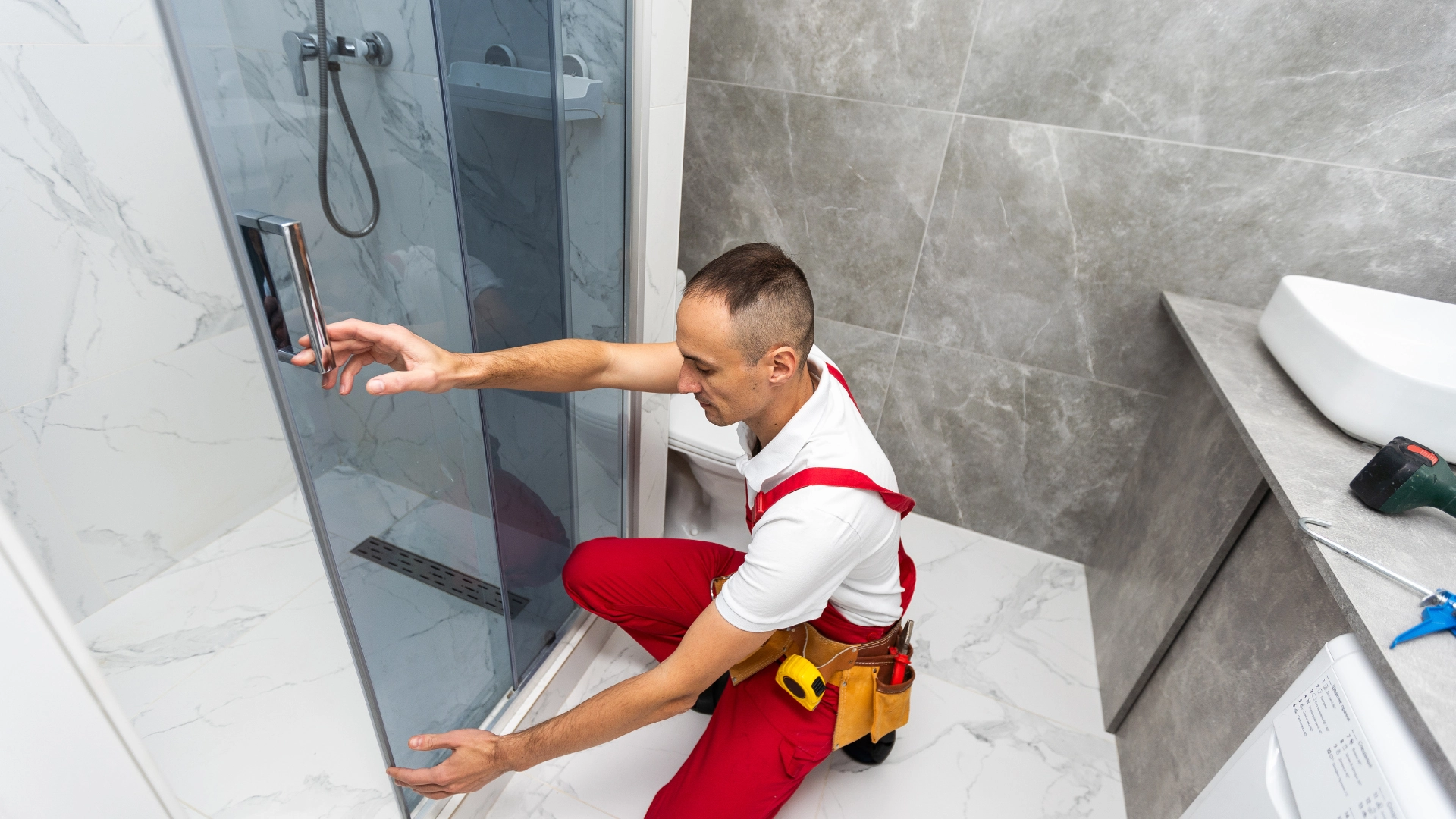
Removing a shower screen on the Gold Coast requires four things: the right tools, the correct removal sequence for the specific screen type (framed, semi-frameless, or frameless), protection for the waterproofing membrane beneath the tiles, and safe handling of toughened glass panels β€” which can weigh 30–50kg for frameless configurations. Getting any one of these wrong is how tiles crack, how waterproofing membranes get breached, and how a straightforward shower screen removal becomes a costly repair job before a new screen can even be ordered. This guide covers the full removal process by screen type, the waterproofing considerations that are specific to Gold Coast bathroom construction, and when professional removal is the more sensible call.


What Tools Do You Need to Remove a Shower Screen Safely?

Having the right tools before you start is not a formality. The tools below are the minimum for a clean shower screen removal β€” using improvised substitutes for any of them significantly increases the risk of tile damage and glass breakage.

  • Stanley knife or silicone removal tool β€” purpose-built silicone removal tools have a hooked blade that runs along the tile face without cutting into the grout or tile surface. A new Stanley knife blade works in the same way. Never use an old, rounded blade β€” it drags rather than cuts and you will apply more force than necessary.
  • Flat pry bar (small) β€” for releasing frame channels from wall fixings after all silicone is cut. The flat profile distributes leverage across the frame rather than concentrating it at a single point that can lever tiles off the wall.
  • Suction cups β€” essential for handling glass panels once they are free of their fixings, particularly for semi-frameless fixed panels and frameless panels. A single 10mm frameless door panel can weigh 30–50kg depending on its dimensions β€” it cannot be safely held by hand alone while being moved clear of the opening.
  • Drop sheets and cardboard β€” laid over the shower base, floor tiles, and any adjacent tiles before removal begins. Toughened glass, if it breaks, does so into small fragments rather than large shards β€” but those fragments spread across every surface instantly. Cardboard also protects the base from the frame and fixings as they come off the wall.
  • Safety glasses and heavy work gloves β€” toughened glass fragments are not sharp-edged in the way standard glass is, but glass dust and small chips are an eye and skin hazard. Glasses and gloves are non-negotiable for any glass removal work.
  • Drill with extraction bit β€” for removing wall plugs and fixings cleanly after the frame is off. Leaving old plugs in the wall creates problems for the new screen’s fixing positions.

Pro Tip: Photograph every fixing position and silicone line before you start cutting. This gives you a reference for where waterproofing membrane boundaries are likely to sit β€” particularly at the base of the wall and around floor-level fixings β€” before you drill anything out.


How Do You Remove a Framed Shower Screen Step by Step?

Framed shower screens are the most common type in older Gold Coast homes β€” particularly those built in the 1970s 80s and 90s β€” and they follow a consistent removal sequence. The key principle is to release everything before moving anything: silicone first, fixings second, glass and frame third.

Step 1: Remove the door β€” open the door to 90 degrees and lift it clear of the hinge pins. Framed screen doors are typically hung on lift-off hinges β€” lifting the door straight up while it is open releases it from the fixed hinge body. Set the door panel outside the shower base on the drop sheet.

Step 2: Cut all silicone joints β€” using your silicone removal tool, cut every silicone bead where the frame meets the wall and where the frame meets the floor. Work the blade along the full length of each junction in a single continuous pass. Do not skip any joint β€” a frame that is still partially bonded to the wall by silicone will transfer all the removal force directly to the tiles when you try to move it.

Step 3: Remove fixed glass panels β€” with the door clear, the fixed panel or panels can be moved. Check that all silicone at the frame-to-wall junctions is fully cut before applying any lateral force. The panel should slide or pivot free once silicone is released and fixings are loosened β€” if it resists, there is silicone still bonded somewhere. Find it and cut it before continuing.

Step 4: Remove the frame channels β€” once glass is clear, the aluminium head rail, side jambs, and bottom channel are removed one section at a time. Remove visible screws first, then work the flat pry bar gently behind the channel to release it from the wall surface. Work along the length of the channel rather than levering at a single point.

Step 5: Extract wall fixings and plugs β€” once all frame sections are removed, extract any remaining wall plugs using the drill. Do not leave plugs in the wall β€” they create high points that affect the new screen’s frame seating.

The most common cause of tile damage during framed screen removal is pulling panels or frame sections while silicone is still bonded. Take your time on Step 2 β€” the silicone cutting is the work that protects your tiles.


How Do You Remove a Semi-Frameless or Frameless Shower Screen?

Semi-frameless and frameless screens share the same principles as framed removal β€” Door first, silicone second, fixings third, glass forth β€” but the handling requirements are more demanding because the glass panels are larger, heavier, and not supported by a full perimeter frame when they come free.

Semi-Frameless Screens

Semi-frameless removal follows the framed sequence closely: remove the door first, cut all silicone at the head rail, side jamb, and base; then remove the fixed panel or panels using suction cups. The head rail and side jamb channel come off last, after the glass is safely clear. The main handling consideration is the fixed panel β€” without a perimeter frame, the glass panel has no secondary support once the head rail fixings are released. Have a second person on suction cups before you loosen anything structural.

Frameless Screens β€” Panel Weight and Pivot Systems

Frameless shower screen removal requires the most care of any screen type. A single 10mm frameless door panel in a standard 900mm opening weighs approximately 30–35kg; in a 1,200mm opening, closer to 45–50kg. This is not a one-person job, and suction cups are not optional β€” they are the primary means of controlling the panel once hinges are released.

For wall-fixed hinge systems:

  • Cut silicone at all glass-to-wall and glass-to-floor junctions before touching any fixings.
  • With a second person holding the panel on suction cups, loosen (but do not fully remove) the hinge body fixings at the wall.
  • Once fixings are loosened, the panel can be eased away from the wall and moved clear while being fully supported.
  • Remove hinge bodies and clamps from the wall last, after the glass is safely stored flat.

Important: Frameless panels stored on their edge on a hard floor surface are a safety risk. Always store removed glass panels flat, separated by cardboard, in a clear area away from foot traffic. A 10mm frameless panel standing on its edge can fall without warning and cause serious injury.


How Do You Protect the Waterproofing When Removing a Shower Screen?

This is the most important section of any shower screen removal guide β€” and the one most often skipped. The waterproofing membrane beneath your bathroom tiles is what prevents water from migrating into the wall cavity and subfloor. It is also the most expensive thing to repair if it is damaged during removal. In Gold Coast bathroom construction, the membrane typically sits beneath the tile adhesive bed β€” roughly 10–20mm inside the wall surface at fixing points.

Here is where the risk is concentrated:

  • Bottom rail and floor-level fixings β€” fixings that penetrate the floor tile and the screed beneath are the most likely to reach or damage the floor membrane. Any fixing at floor level should be removed slowly and with controlled extraction β€” a drill running too fast through a floor fixing can pull the surrounding membrane up with the plug.
  • Wall fixings within 100mm of the floor β€” Waterproofing actually goes to 1800mm high in a shower. Fixings in this zone can penetrate the upstand section of the membrane. After removal, check the tile surface in this zone carefully for any sign of the membrane pulling away from the adhesive bed.
  • Areas where silicone has been masking a leak β€” if the silicone line at the base of your shower screen has black mould growing beneath it, or if there is tile discolouration at the base of the screen, there is a reasonable possibility that water has already reached the membrane. Do not assume that removing the screen and resealing is sufficient β€” inspect for loose tiles, as this is often a sign of a failed waterproofing membrane

After removal, clean all silicone residue from the tile faces completely before assessing the membrane condition. Residual silicone masks the surface and makes it impossible to see whether tiles are lifting, whether grout lines are compromised, or whether there is staining that indicates prior water ingress. A damp or discoloured area on the bare tile surface after silicone removal is a signal to investigate further before ordering a new screen.

Pro Tip: If you see any sign of membrane damage or prior water ingress after removal, stop and call a licensed waterproofer before proceeding with a new screen installation. Installing a new screen over compromised waterproofing locks the problem behind the new silicone line β€” where it will continue to cause damage, unseen, until cabinetry swells or tiles begin to lift.


What Are the Most Common Mistakes When Removing a Shower Screen?

These are the errors that turn a routine remove shower screen job into a tile repair or waterproofing remediation:

  • Pulling panels before all silicone is cut β€” the single most common cause of tile damage during shower screen removal. The bond strength of cured silicone is considerable β€” a panel pulled while partially bonded will bring tiles with it. Cut every millimetre of silicone before applying any force to glass or frame.
  • Not using suction cups on heavy glass panels β€” frameless panels and large semi-frameless fixed panels are too heavy to control by hand. A panel that slips during removal will either break against the shower base or fall outward onto floor tiles. Neither outcome is recoverable without additional cost.
  • Using excessive force to remove frame channels β€” corroded fixings and old silicone make aluminium frames reluctant to come away cleanly. The temptation is to lever harder. The correct approach is to cut more silicone, work a thin blade behind the frame to release any remaining bond, and extract fixings individually before applying any outward force.
  • Leaving silicone residue on tile faces β€” old silicone must be completely removed before a new screen can be sealed correctly. Silicone does not bond reliably to cured silicone β€” new silicone applied over residue will peel within months.
  • Disposing of toughened glass incorrectly β€” old toughened glass panels cannot simply be placed in a general skip or broken up with a hammer. Toughened glass must be handled carefully, wrapped, and disposed of at a facility that accepts it. Many councils on the Gold Coast do not accept toughened glass in kerbside bins. Check disposal requirements before the removal day.

When Should You Call a Professional Instead of Removing It Yourself?

DIY shower screen removal is viable in specific circumstances: a framed screen in good condition, walls in reasonable shape, tiles that are well-bonded, and no signs of prior water ingress. Outside those conditions, the risk calculus shifts.

Call a professional glazier for shower screen removal if:

  • The screen is frameless β€” 10mm frameless panels are heavy, the hinge release sequence is unforgiving, and the consequences of a dropped panel are immediate and expensive. This is a two-person job at minimum, and a professional team will have the suction equipment and experience to manage the weight safely.
  • The screen is in a Gold Coast apartment building β€” removal in an apartment building involves disposal logistics, building management coordination, and confined-space handling that are significantly more complex than a freestanding house. A professional team handles this as a routine part of the job.
  • There is visible tile damage or silicone failure at the base β€” if the existing screen has been leaking, removal may expose waterproofing damage that requires a professional assessment before proceeding. A glazier who assesses during removal can advise on whether waterproofing remediation is needed before a new screen goes in.
  • The screen predates 2000 β€” older framed screens, particularly those installed in the 1980s and early 1990s, were sometimes fixed using adhesive bonding rather than screwed fixings, or with fixings that extend significantly deeper into the wall. Removal without professional assessment risks removing more wall substrate than expected.

For a full companion guide to the removal process, see Gold Coast Shower Screens’ existing guide: How to Remove a Shower Screen β€” A Simple, Safe Guide.


What Should You Do After the Screen Is Removed?

The post-removal checklist is the foundation for a successful replacement. Everything that happens next β€” waterproofing repair, new measure, new screen installation β€” depends on an accurate assessment of what the removal has revealed.

  • Remove all silicone residue β€” use a dedicated silicone remover product and a plastic scraper on all tile faces where the screen was bonded. This is time-consuming but cannot be skipped β€” the new silicone application depends on a clean, bare tile surface.
  • Inspect the waterproofing β€” with silicone residue cleared, examine the base of the walls and floor within the shower recess. Look for tiles that flex underfoot (sign of membrane failure beneath the adhesive bed), dark staining in grout lines, and tile edges that have lifted slightly from the wall substrate. Any of these warrants a professional assessment before proceeding.
  • Check wall plumb and floor fall β€” use a spirit level on each wall face within the shower opening. Check floor fall toward the drain. These measurements feed directly into the new screen design β€” a wall that is 5mm out of plumb at the top of a 2,000mm opening requires a glass panel that is cut to a parallelogram, not a rectangle. This cannot be guessed from a photograph.
  • Book the measure appointment β€” a measure for a new screen should be taken only after silicone residue is fully cleared and the opening is in its final condition. A measure taken over residual silicone or before old tile repairs are complete produces inaccurate dimensions.

For guidance on what replacement costs and what the full installation process involves from here, see our guide to shower screen repairs and replacement on the Gold Coast and our guide to shower screen manufacturers and the supply and install process.


Final Thoughts

Removing a shower screen without damaging tiles or waterproofing comes down to sequence and patience. Cut all silicone before moving anything. Use suction cups for any panel that is too heavy to control by hand. Handle frameless panels as the 30–50kg objects they are, not as glass panes that can be carried casually. And treat the post-removal inspection as seriously as the removal itself β€” what is underneath the old screen determines everything about the new one.

When conditions are straightforward, this is a manageable job for a careful DIYer. When they are not β€” frameless screens, apartment buildings, signs of water ingress, older construction β€” the professional route is the more cost-effective one, even before the complications are factored in.

Gold Coast Shower Screens can handle professional shower screen removal and replacement across the Gold Coast β€” including assessment of waterproofing condition during removal. If removal has revealed tile damage or waterproofing issues, contact us for a free assessment and we will advise on the most cost-effective path to a new screen.

Frameless fixed radius panel shower screen with brushed gold hardware, open walk-in configuration and linear drain

Frameless Shower Screens Gold Coast: Everything You Need to Know

Frameless shower screens Gold Coast homeowners choose use 10mm toughened safety glass, wall-fixed hinges or pivot clamps, and no aluminium perimeter frame. The result is an uninterrupted glass surface that maximises light and sightlines. Furthermore, they comply with AS 1288:2021 and AS/NZS 2208 safety glazing standards. The 10mm glass carries its own structural load β€” so there is no surrounding channel. The only visible hardware is the hinges, clamps, and handles chosen at measure. For new builds, full renovations, and premium ensuites, frameless shower screens Gold Coast represent the highest-performing option when conditions support them. This guide covers exactly what those conditions are, what coastal hardware involves, what installation requires, and how to find the right specialist.


What Makes Frameless Shower Screens Gold Coast Truly Frameless?

The term frameless is used loosely in the market β€” sometimes applied to screens that still have a bottom channel or a visible head rail. A genuinely frameless shower screen has none of these: no aluminium channel at the head, no bottom rail at the floor, no side jamb. The glass panels are fixed directly to the wall using hinge bodies or clamps, and the door hangs from those fixings alone.

What that requires structurally:

  • 10mm toughened safety glass β€” the glass specification for a frameless screen is non-negotiable. 10mm toughened glass is approximately four times stronger than standard glass of the same thickness, and it is the minimum required to carry its own structural load without a surrounding frame. A screen using 6mm glass and marketed as ‘frameless’ has a frame β€” it may just be less visible. AS/NZS 2208 compliance applies to all shower screen glass regardless of type.
  • Wall-fixed hinges or pivot clamps β€” the hinge body or clamp is the only connection between the glass and the wall. The fixing must be anchored into confirmed solid backing β€” timber noggin, concrete, or a steel stud β€” not just into plasterboard or tile adhesive. This is why frameless installation requires a pre-installation structural check at every proposed fixing location.
  • Magnetic door seal and polycarb base sweep β€” these are the only seals on a genuinely frameless screen. No perimeter channel means no channel seal β€” water containment relies entirely on the door seal engagement and the accuracy of the silicone at the base. This is also why frameless screens are the easiest of all screen types to clean: there are no channels for soap scum to accumulate in.

Frameless shower screens Gold Coast installations are the most technically demanding screen type. They are also the most likely to reveal poor workmanship quickly. That is precisely why choosing the right installer matters.


Frameless vs Semi-Frameless vs Framed β€” Which Is Right for Your Gold Coast Bathroom?

The right screen depends on your wall conditions, budget, and aesthetic goal. So, how do frameless shower screens Gold Coast compare to the alternatives? Here is the breakdown across factors that matter most locally.

FramelessSemi-FramelessFramed
Glass thickness10mm toughened6mm toughened4–6mm toughened
Visual impactMaximum β€” fully unobstructed glass surfaceOpen β€” minimal frame profileDefined β€” visible perimeter frame
Cleaning effortLowest β€” no frame channels at allLow β€” minimal channels onlyHigher β€” perimeter channels trap grime and mould
Wall toleranceLow β€” walls must be plumb to tight tolerancesHigh β€” channel accommodates minor varianceHighest β€” frame conceals gaps and imperfections
Coastal corrosion riskHigher β€” exposed marine-grade hardware essentialModerate β€” minimal channel exposureHighest β€” maximum aluminium surface area
Installation visits2 visits (hinged door)1 visit1 visit
Relative cost$$$$$$
Best suited toNew builds, full renovations, premium ensuites β€” plumb walls, solid backing confirmedMost Gold Coast bathrooms β€” apartments, renovations, family ensuitesBudget replacements, rental properties

In short, frameless shower screens Gold Coast deliver the best result when the aesthetic is the priority and the bathroom genuinely supports it β€” plumb walls, solid backing, and a budget for the two-visit process. For most Gold Coast bathrooms, however, semi-frameless screens deliver 80 per cent of the visual result at a lower price and in a single visit. For the right bathroom, though, frameless is the finish that makes the room. See our full guide on frameless vs semi-frameless shower screens on the Gold Coast for a detailed comparison.


What Hardware Options Are Available for Gold Coast Conditions?

Hardware matters more for frameless shower screens Gold Coast than for any other screen type. Frameless hardware carries full structural load. Moreover, it faces more exposure to the bathroom environment than any framed or semi-frameless equivalent. In Gold Coast conditions, that means salt air in beachside suburbs, sustained high humidity, and daily contact with soap and cleaning products.

Marine-Grade Stainless Steel

Grade 316 marine stainless steel or solid brass is the correct specification for frameless shower screen hinges, clamps, and handles in Gold Coast coastal suburbs β€” Surfers Paradise, Broadbeach, Mermaid Beach, Burleigh Heads, Coolangatta, Runaway Bay, and Hope Island. Grade 304 stainless, which is standard in most mainland Australian installations, is adequate for non-coastal environments but will show surface oxidation within 3–5 years in direct salt-air exposure. The difference between 304 and 316 is the addition of molybdenum in the alloy β€” this gives 316 significantly better resistance to chloride corrosion. It is not visible to the naked eye and it is not always volunteered by installers. Ask for it specifically.

Powdercoated Aluminium and Zinc Alloy Hardware

Handles and some hinge components for frameless shower screens are available in powdercoated zinc alloy or aluminium. In Gold Coast coastal conditions, powdercoating quality is the variable that determines longevity β€” a quality thermosetting powdercoat applied to a correctly prepared substrate will resist coastal corrosion effectively. A thin decorative coat applied over untreated casting will chip, lift, and corrode within a few years in a beachside bathroom.

Finish Options and Coastal Performance

The four standard finish options for frameless shower door gold coast hardware β€” and how each performs in a coastal climate:

  • Polished chrome β€” the most durable surface finish in humid conditions. Chrome is electroplated onto the base metal and creates a hard, non-porous surface that resists moisture and cleaning chemicals well. It will show water spots in beachside bathrooms unless wiped down regularly, but it does not corrode.
  • Matte black β€” the dominant choice in current Gold Coast renovations. The matte finish hides water spots better than polished chrome, but the powdercoat quality beneath the finish is what determines longevity in coastal conditions. Specify thermosetting powdercoat, not UV-cure.
  • Brushed nickel β€” a warm mid-tone that complements stone tiles and timber vanities. Performance in coastal humidity is comparable to matte black β€” finish quality depends on coating process, not colour.
  • Brushed gold β€” the premium finish choice in current Gold Coast luxury renovations. A physical vapour deposition (PVD) coating rather than a plated or painted finish β€” significantly more durable than traditional gold plating in humid conditions. Specify PVD rather than electroplated gold if longevity in a coastal bathroom matters.

Pro Tip: Confirm the hardware grade specification in writing before your installation is booked β€” not verbally at the measure appointment. If the quote does not specify 316 marine stainless steel for coastal suburbs, or thermosetting powdercoat for matte black or brushed finishes, ask for it to be added. Hardware replacement on a frameless screen is a significant job β€” getting the specification right from the start is the better investment.


How Much Do Frameless Shower Screens Gold Coast Cost?

Frameless shower screens sit at the premium end of the shower screen market β€” and understanding precisely what drives the cost helps you evaluate whether the premium is justified for your specific bathroom.

The main cost drivers are:

  • 10mm glass β€” heavier, more expensive to manufacture and transport than the 6mm glass used in semi-frameless screens. A single 10mm frameless door panel in a standard 900mm opening weighs 30–35kg; at 1,200mm, closer to 45–50kg. The glass cost, the processing cost, and the handling cost are all higher than semi-frameless equivalents.
  • Precision marine-grade hardware β€” grade 316 stainless steel hinges, clamps, and pivots are engineered to tighter tolerances than standard glazing hardware and carry a significant material premium over grade 304 equivalents or powdercoated zinc alloy fittings.
  • Two-visit installation β€” frameless hinged door screens require two installation visits. Fixed panels first; the door manufactured to the confirmed gap measurement and installed at the second visit. This doubles the on-site time compared to a semi-frameless or framed installation and adds to the total cost accordingly.
  • Site preparation requirements β€” frameless installation requires walls within a tighter plumb tolerance, confirmed solid backing at every hinge fixing point, and a precise floor fall assessment. Sites that do not meet these conditions without preparation work add to the total cost before installation begins.

Is the premium justified? For a new build or full renovation β€” where tiles, tapware, and vanity are all being replaced together β€” the extra cost of frameless shower screens Gold Coast over semi-frameless is a small share of total spend. The visual return, however, is significant. For a straightforward screen replacement where everything else is staying, semi-frameless is often the smarter choice. For detailed replacement cost context, see our guide to shower screen repairs and replacement on the Gold Coast.


What Does Installing Frameless Shower Screens Gold Coast Actually Involve?

Frameless shower screens Gold Coast installation is the most demanding of all screen types. Poor workmanship shows up quickly. Consequently, the two-visit sequence is not optional for hinged door configurations β€” it is what makes the result look and perform correctly.

Visit One: Fixed Panels and Structural Elements

The first visit fits all fixed components β€” side panels, return panels, wall-fixed clamps, and any pivots. Each fixing is anchored into confirmed solid backing. Once all fixed elements are plumb and sealed, the door gap is measured at multiple heights and widths. Importantly, this confirmed gap measurement β€” not the original design drawing β€” is what the door panel is manufactured to.

The Confirmed-Gap Measurement

This step separates a correct frameless installation from a shortcut. Because 10mm glass cannot be trimmed on site, the door must be manufactured to the actual installed gap. In any real Gold Coast bathroom, that gap will differ from the design drawing by 2–5mm β€” due to tile thickness, wall plumb tolerance, and fixing compression.

Visit Two: Door Installation and Alignment

The door panel arrives manufactured to the confirmed gap. It is hung on the fixed hinges and adjusted through its full range of motion β€” hinge angle, seal engagement, base sweep contact, and stop position. Every adjustment happens on site before sign-off. Finally, silicone is applied at all glass-to-wall and glass-to-floor junctions, and the shower must not be used for 24 hours while it cures.

For a full step-by-step overview, see our guide on how to install a shower screen.


How Do You Keep a Frameless Shower Screen Clean in a Coastal Climate?

Frameless glass shower screens gold coast are the easiest shower screen type to maintain β€” but coastal conditions add two variables that standard cleaning advice does not account for: mineral deposits from Gold Coast tap water and salt residue from coastal humidity in beachside suburbs.

Daily: The Squeegee Habit

A 30-second squeegee after every shower is the single most effective maintenance habit for any glass shower screen, and most critical for frameless glass. Removing water before it evaporates eliminates the primary mechanism by which mineral deposits form β€” there is nothing to leave behind if the water is gone. A quality squeegee used consistently means the weekly clean is a two-minute wipe rather than a scrub session.

Weekly: Mineral and Salt Residue

A 1:1 solution of white vinegar and water sprayed on the glass surface, left for 5 minutes, and wiped with a microfibre cloth removes both mineral film from tap water and salt residue from coastal humidity. This is particularly important for frameless shower screens in Surfers Paradise, Broadbeach, Mermaid Beach, and Coolangatta, where salt air deposits on glass surfaces noticeably faster than in inland suburbs. The vinegar solution is safe on toughened glass and stainless hardware β€” it is not safe on natural stone tiles or stone benchtop surfaces adjacent to the screen.

Monthly: Hardware and Seal Maintenance

Wipe all exposed hardware β€” hinges, clamps, handles β€” with a damp cloth to clear salt residue and soap accumulation. Check that the magnetic door seal engages cleanly along its full length when the door is closed: a seal that contacts firmly at the top and gaps at the base, or vice versa, is a sign the hinge needs adjustment, not that the seal needs replacing. In beachside suburbs, rinse all hardware with clean fresh water after the monthly wipe.

Nano-Coating

Gold Coast Shower Screens applies hydrophobic nano-coatings to frameless screens at the time of installation. The coating creates a microscopically smooth surface that causes water β€” including salt-laden coastal humidity β€” to bead and run off rather than sheet and evaporate, dramatically reducing the rate at which both mineral deposits and salt residue form. A nano-coating applied at installation, when the glass is perfectly clean and freshly manufactured, provides significantly better long-term performance than coatings applied to glass that has already developed a mineral film.


How Do You Find a Frameless Shower Screens Gold Coast Specialist?

Not all glaziers handle frameless shower screens Gold Coast work. The two-visit process, the demands of 10mm glass, the marine-grade hardware spec, and the precision required at every fixing point make this a specialist skill. Moreover, the quality gap between an experienced frameless installer and a generalist is visible in the finished result from day one.

When evaluating frameless shower screen specialists on the Gold Coast, look for:

  • QBCC licence β€” Queensland requires a QBCC licence for structural glazing work. Ask for the licence number before engaging anyone. It is publicly verifiable on the QBCC licence check website. An unlicensed installer cannot issue the Form 15 and Form 16 compliance certificates that confirm your installation meets AS 1288:2021 and AS/NZS 2208.
  • Two-visit process for hinged doors β€” this is the most reliable quality indicator for any frameless shower screen specialists gold coast. Any installer offering to complete a hinged door frameless screen in a single visit is either cutting the door to the design drawing rather than the confirmed installed gap, or supplying a standard-size pre-cut door rather than a custom-manufactured one. Ask directly: how many visits does this installation require, and when is the door dimension confirmed?
  • Custom manufacture β€” a manufacturer who cuts glass in their own workshop to your confirmed dimensions has direct control over quality, tolerance, and timeline. An installer ordering from a third-party fabricator has less control over all three. For a frameless screen where the door must fit a confirmed gap to within 2mm, in-house manufacture is a meaningful quality advantage.
  • Marine-grade hardware specification β€” this should be standard for any Gold Coast installation, not an optional upgrade. If the quote does not specify 316 marine stainless for beachside suburbs, or if the installer cannot explain the difference between 304 and 316 grade when asked, that is a gap in coastal experience that will show up on the hardware within a few years.
  • Workmanship warranty β€” a manufacturer-installer can warrant both the product and the installation. If the silicone fails, a hinge works loose, or alignment drifts within the warranty period, it is rectified without cost. Ask for the warranty terms in writing before signing off on the quote.

Gold Coast Shower Screens installs frameless shower screens gold coast wide β€” Surfers Paradise, Broadbeach, Burleigh Heads, Robina, Southport, Nerang, Ashmore, Helensvale, Coomera, Hope Island, Runaway Bay, Labrador, Parkwood, Molendinar, and Tweed Heads.


Final Thoughts

Frameless shower screens Gold Coast represent the premium end of the market. For the right bathroom β€” installed correctly by a licensed specialist with genuine local experience β€” they are worth every dollar. The 10mm glass, marine-grade hardware, two-visit process, and nano-coating all contribute to a result that outperforms any framed alternative over time.

Conditions matter just as much as the product. Walls must be plumb. Solid backing must be confirmed at every fixing point. Furthermore, the glazier must understand the two-visit process and not shortcut it. When those conditions are met β€” in a new build, full renovation, or premium ensuite β€” the result is a bathroom that looks as though it was always designed this way.
Gold Coast Shower Screens specialises in frameless and semi-frameless custom shower screens β€” designed, manufactured, and installed by our own QBCC-licensed glaziers across the Gold Coast. Contact us for a free frameless measure and quote, or use the Instant Estimate form for a quick price guide.
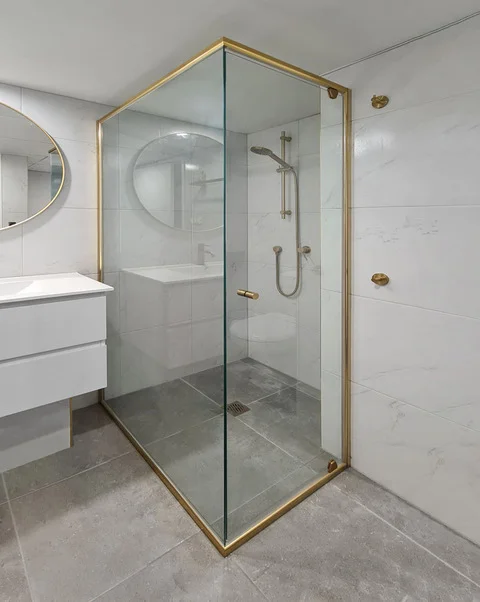
Open wetroom with frameless fixed glass panel, brushed gold tapware, grey terrazzo tiles, timber floating vanity, and arched mirror in a Gold Coast ensuite bathroom

Best Semi Frameless Shower Screens Gold Coast: Complete Guide

The result is a clean, open aesthetic that sits close to fully frameless in appearance, at a lower cost, and with greater tolerance for the imperfect wall conditions found in most Gold Coast homes and apartments. There is no bulky perimeter frame on all four sides, no channel trapping moisture along the base, and far fewer mould trap points than a traditional framed screen. For the majority of Gold Coast bathrooms β€” from beachside apartments in Surfers Paradise to family ensuites in Robina β€” semi frameless shower screens gold coast represent the most practical balance of aesthetics, durability, and value.

Here is everything you need to know before making a decision: how they are built, how they compare to the alternatives, which styles work in which layouts, what they cost on the Gold Coast, and what professional installation involves.


What Are Semi Frameless Shower Screens Gold Coast and How Are They Built?

The defining feature of a semi-frameless shower screen is what is absent. There is no continuous aluminium frame encasing the glass on all four sides. Instead, a slim channel sits at the head (top) and at one side jamb where the screen fixes to the wall, with the door hung on polished or powdercoated hinges. The glass itself carries most of the structural load β€” which is why glass specification and fixing positions matter.

A typical semi-frameless shower screen on the Gold Coast is built from the following components:

  • 6mm toughened safety glass β€” manufactured to AS/NZS 2208, the Australian Standard for safety glazing materials. At 6mm, the glass is rigid and impact-resistant without the weight or cost of the 10mm glass used in fully frameless screens.
  • Slim aluminium channel β€” at the head rail and one side jamb only. No bottom rail. No full perimeter. The channel is powdercoated or anodised in the finish specified at the measure appointment: chrome, matte black, brushed nickel, or brushed gold.
  • Hinged door β€” most configurations use a hinged door with polished or powdercoated hardware. The door must swing outward or be dual-action to comply with the National Construction Code. Sliding configurations are available where door swing clearance is restricted.
  • Silicone sealing β€” at all wall junctions and along the base, creating the watertight barrier that protects the waterproofing membrane beneath your tiles.

The practical difference from a framed screen is immediately visible: less hardware, more exposed glass, and a notably lighter visual presence in the room. The practical difference from a fully frameless screen is equally clear: semi-frameless installation is completed in a single visit, the 6mm glass is lighter and easier to handle, and the aluminium channel provides enough adjustment tolerance to accommodate the slightly out-of-plumb walls that are common in both older Gold Coast homes and apartment buildings.


Semi-Frameless vs Frameless vs Framed β€” Which Is Right for Your Gold Coast Bathroom?

The right screen type depends on your bathroom layout, wall conditions, budget, and what you’re trying to achieve aesthetically. Here is how the three types compare:

Semi-FramelessFramelessFramed
Glass thickness6mm toughened10mm toughened4–6mm toughened
Visual impactOpen, minimal frame profileFully unobstructed glass surfaceVisible frame on all four sides
Cleaning effortLow β€” minimal channelsLowest β€” no channels at allHigher β€” perimeter channels trap grime
Water containmentGood β€” improved with return panelGood with correct layoutVery good β€” full perimeter seal
Wall toleranceHigh β€” channel accommodates minor varianceLow β€” walls must be plumbHighest β€” frame conceals imperfections
Relative cost$$$$$$
Installation visits1 visit2 visits (hinged door)1 visit
Best suited toMost Gold Coast bathrooms β€” apartments, ensuites, renovationsNew builds, full renovations where walls are plumbBudget replacements, rental properties

Semi-frameless shower screens are the most popular choice across the Gold Coast residential market β€” they deliver the majority of the visual benefit of fully frameless at a lower price, in a single installation visit, and with significantly better tolerance for real-world wall conditions. Fully frameless screens are the right choice when the aesthetic outcome is the priority and the bathroom genuinely supports it: plumb walls, solid backing at every fixing point, and a budget that accommodates the premium.


Conditions?

Gold Coast bathrooms face specific environmental conditions that influence which screen type performs best over time. Semi-frameless screens are particularly well-matched to these conditions.

Salt-Air Corrosion

In beachside and broadwater suburbs β€” Surfers Paradise, Broadbeach, Mermaid Beach, Burleigh Heads, Coolangatta, Runaway Bay, Hope Island β€” salt air accelerates corrosion on hardware and aluminium framing. Semi-frameless screens expose less aluminium to the environment than framed screens, which reduces the total surface area at risk. Gold Coast Shower Screens specifies marine-grade stainless steel hardware and powdercoated aluminium channels for all coastal installations β€” the powdercoating creates a sealed barrier between the aluminium substrate and the salt-laden air. A raw anodised finish in a beachside bathroom will show visible oxidation within a few years. A quality powdercoat will not.

Humidity and Mould

The Gold Coast’s subtropical climate β€” warm temperatures, high relative humidity, and significant seasonal rainfall β€” creates ideal conditions for mould growth in bathrooms. Fully framed shower screens have a continuous channel at all four sides of the glass, and this channel is a persistent mould trap: water sits in it, silicone discolours, and cleaning it requires effort and a detail brush. Semi-frameless screens, with channel at the head and one jamb only, remove the bottom rail and door-edge frame entirely. Fewer channel sections mean fewer trap points, less silicone surface to maintain, and a noticeably faster weekly clean.

Apartment and High-Rise Bathrooms

The Gold Coast has a higher proportion of apartment buildings than most Australian cities β€” from the high-rise towers of Surfers Paradise and Broadbeach to the low-rise units of Ashmore, Labrador, and Nerang. Semi-frameless screens are well-suited to apartment bathrooms for three reasons: the channel provides adjustment tolerance for the slightly out-of-plumb walls common in older apartment construction; single-visit installation means less disruption in a strata building where access must be arranged with building management; and nib wall configurations β€” fixed to a half-wall rather than a full-height wall β€” are straightforward to manufacture and install in a single visit.

Pro Tip: Gold Coast Shower Screens takes every measure after tiling is fully complete β€” not before, and not from your measurements over the phone. Final glass dimensions are cut to the actual finished opening in your bathroom. This is why custom-manufactured screens fit without gaps, and why standard off-the-shelf screens in fixed sizes almost never do in a real Gold Coast bathroom.


Which Semi-Frameless Styles Work Best in Different Bathroom Layouts?

Semi-frameless shower screens are available in several configurations. The right one depends on your shower’s footprint, wall arrangement, and whether you have a door swing restriction.

Front-Only with Hinge Door

The most common configuration in Gold Coast ensuites and main bathrooms. A single fixed panel runs across the front of the shower recess, with a hinged door at one end. Well-suited to showers enclosed on three sides by full-height walls. The door must swing outward or be dual-action β€” inward-only is non-compliant with the National Construction Code.

Front-Return (L-Shape)

Two panels at right angles β€” one across the front of the shower, one returning along an open side. This configuration improves water containment significantly in corner showers and open alcoves, which are common in Robina, Helensvale, Coomera, and Southport home designs where bathroom footprints tend to be more generous. The return panel is typically fixed; a second hinged door can be added if access from both sides is needed.

Nib Wall Configuration

Where a shower is built with a half-wall (nib wall) rather than full-height walls on all sides, the semi-frameless screen fixes to the top of the nib using a structural head rail. The glass panel sits above the nib, with the door hinge fixed to the wall or side jamb. This layout is common in apartments and townhouses across Southport, Labrador, and Ashmore β€” and it requires custom glass cut to the exact dimensions of your opening. Standard off-the-shelf screens cannot accommodate nib wall configurations.

Sliding Semi-Frameless

Where door swing clearance is restricted β€” the shower faces a vanity, toilet, or bathroom door β€” a sliding configuration removes the swing requirement entirely. The door travels along a concealed head rail. This is the most practical choice in compact Gold Coast apartment bathrooms where every centimetre of floor space is occupied.


How Much Do Semi Frameless Shower Screens Gold Coast Cost?

Semi-frameless shower screens sit in the mid-range of the shower screen market β€” above entry-level framed screens, and below the premium cost of fully frameless installations. Understanding what drives the cost helps you evaluate quotes accurately and avoid paying for complexity you don’t need.

The main cost variables for semi frameless shower screens gold coast are:

  • Configuration β€” a front-only panel with a single hinged door is the most cost-efficient. A front-return (L-shape), nib wall setup, or sliding configuration adds glass area and hardware complexity, which increases cost.
  • Hardware finish β€” chrome is the most accessible price point. Matte black, brushed nickel, and brushed gold involve additional powdercoating and carry a modest premium. Marine-grade hardware for coastal locations adds a small cost but is worth specifying β€” it will outlast standard hardware by years in beachside suburbs.
  • Glass area β€” custom glass is priced by the square metre. A 900mm shower and a 1,200mm shower require different amounts of glass, and door panel dimensions differ accordingly.
  • Site conditions β€” out-of-plumb walls requiring glass cut at non-standard angles, high-rise access with lift logistics, or unusual fixing conditions add to installation time and material requirements.

The most accurate way to understand cost for your specific bathroom is a free site measure and quote. A site measure is always more accurate than a phone quote β€” and for a custom-manufactured screen, it is the only way to guarantee the glass will fit your opening. Use the Gold Coast Shower Screens Instant Estimate form for a quick price guide before booking a measure.

For cost context on replacing an existing screen β€” including what removal adds to the total β€” see our guide to shower screen repairs and replacement on the Gold Coast.


What Does Professional Installation of Semi Frameless Shower Screens Gold Coast Involve?

Semi-frameless shower screen installation is completed in a single visit β€” one of the practical advantages over fully frameless hinged-door screens, which require two visits because the door must be manufactured to the confirmed gap measurement after fixed panels are set.

The standard installation sequence for a semi-frameless screen is:

  • Site measure (separate prior visit) β€” taken after tiling is fully complete. Wall plumb, floor fall, obstacle positions, and the exact finished dimensions of the opening are recorded. All glass is manufactured to these measurements.
  • Manufacture β€” glass panels are cut and processed in the Gold Coast Shower Screens workshop. Lead time from confirmed measure is typically 5–7 business days.
  • Installation β€” wall fixings are drilled and anchored into confirmed solid backing. The head rail and side jamb are set. Glass panels are hung, checked for plumb and level, and the door is adjusted for smooth, consistent swing.
  • Silicone sealing β€” all junctions between glass, frame, and tile are sealed with waterproof silicone. The screen cannot be used until the silicone has fully cured β€” allow 24 hours minimum.
  • Compliance certification β€” a Form 15 (design) and Form 16 (construction) compliance certificate is issued by the QBCC-licensed supervising glazier, confirming the installation meets AS 1288:2021 and AS/NZS 2208.

DIY installation is not appropriate for shower screens unless you are a licensed glazier. Incorrect fixing positions risk penetrating the waterproofing membrane beneath the tiles β€” damage that may not become visible for months, and which typically costs considerably more to repair than the screen itself. The compliance certificates issued by a licensed installer are also your protection in the event of a building inspection, property sale, or insurance claim. If you are replacing an existing screen yourself, see our guide on how to remove a shower screen safely before the new screen is installed.

For a detailed explanation of what the supply, measure, and install process involves from start to finish β€” including the full service timeline for the Gold Coast β€” see our guide to shower screen manufacturers and installation on the Gold Coast.


How Do You Find Semi Frameless Shower Screens Gold Coast Specialists?

There is a meaningful difference between a manufacturer-installer and a retailer. A manufacturer designs, cuts, and fits glass from their own workshop β€” accountable for every step from measure to completion. A retailer orders pre-cut panels from a national distributor and either subcontracts installation or supplies the product only. For a custom-measured screen in a real Gold Coast bathroom, the manufacturer-installer model provides significantly more accountability, particularly if something needs adjustment after installation.

When evaluating semi-frameless shower screen specialists on the Gold Coast, look for:

  • QBCC licence β€” Queensland requires a QBCC (Queensland Building and Construction Commission) licence for structural glazing work. Ask for the licence number before engaging anyone. It is publicly verifiable on the QBCC website.
  • Custom manufacture capability β€” a manufacturer measures and cuts to your exact dimensions after tiling. A retailer supplies from a fixed size range. For most Gold Coast bathrooms β€” particularly apartments and homes with non-standard openings β€” custom manufacture is necessary for a proper fit.
  • Single-source accountability β€” one company that handles measure, manufacture, and installation is accountable for the entire outcome. When supply and installation are handled by different parties, accountability gaps appear if the screen doesn’t fit, seal, or align correctly.
  • Coastal hardware knowledge β€” marine-grade specification and appropriate hardware selection for Gold Coast conditions should be standard practice, not an upsell. Ask directly whether marine-grade hardware is included for your suburb before you commit.

Gold Coast Shower Screens installs semi-frameless shower screens across Surfers Paradise, Broadbeach, Burleigh Heads, Robina, Southport, Nerang, Ashmore, Helensvale, Coomera, Parkwood, Molendinar, Labrador, Runaway Bay, Hope Island, and Tweed Heads.


Final Thoughts

For most Gold Coast bathrooms, a semi-frameless shower screen delivers the right combination of appearance, practicality, and value. The minimal aluminium framing keeps costs lower than fully frameless while providing the majority of the same visual benefit. The custom-manufactured fit means the screen works with your actual bathroom β€” including nib walls, out-of-plumb surfaces, coastal conditions, and the compact layouts of Gold Coast apartment bathrooms that a standard off-the-shelf screen simply cannot accommodate. And the single-visit installation keeps disruption to a minimum.

The detail that matters most is getting the right configuration for your space, measured correctly after tiling, manufactured precisely, and installed by a licensed glazier with genuine Gold Coast experience.

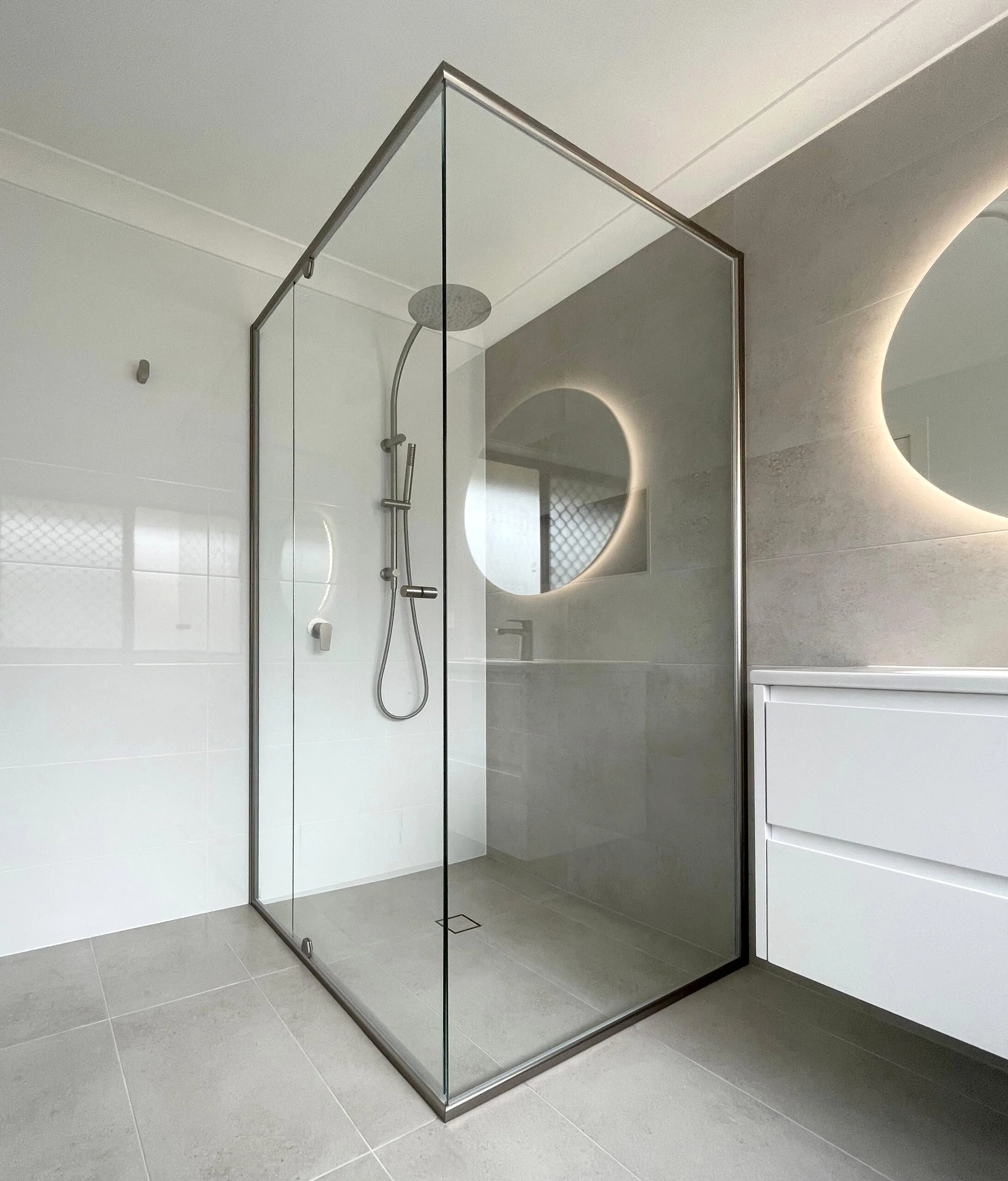
Semi frameless front return shower screen with nickel aluminium channel and ceiling-height glass panels, hinged door and fixed return panel

Shower Screen Repairs and Replacement on the Gold Coast: What You Need to Know

When searching for shower screen repairs Gold Coast homeowners often discover that replacement is the more practical answer β€” particularly where glass is damaged, frames have corroded, or the existing installation no longer meets compliance standards. This guide helps you identify which situation applies to your screen, what shower screen replacement on the Gold Coast actually costs, and how to find a specialist who will give you an honest assessment either way.


Can My Shower Screen Be Repaired, or Does It Need Replacing?

The answer depends on what is actually wrong with the screen. Most shower screen problems fall into one of two categories: component-level failures that can be rectified without removing the glass, and structural or glass-level failures that require full replacement.

Repairable

These issues can almost always be addressed without replacing the screen:

  • Worn or deteriorated door seals and sweeps β€” the rubber or polycarb seal along the door edge and base wears over time, particularly in the Gold Coast’s humid climate. Replacement is straightforward and significantly cheaper than a new screen.
  • Failed or discoloured silicone β€” silicone at wall junctions and the base discolours, cracks, and loses adhesion over time. Resealing requires removing the old silicone, preparing the surface correctly, and applying new silicone in continuous runs. If the waterproofing membrane beneath is intact, this is a repair job β€” not a replacement.
  • Corroded or seized hinges β€” hinges on older Gold Coast screens β€” particularly in beachside suburbs where salt air accelerates oxidation β€” can corrode to the point where the door no longer swings smoothly or closes consistently. Hinge replacement is a repair, not a replacement, provided the glass is undamaged.
  • Door rollers and track on sliding screens β€” worn rollers cause the door to drag, judder, or jump the track. Roller and track replacement is a common repair on older sliding semi-frameless and framed screens.
  • Mould in frame channels β€” heavy mould growth in framed screen channels is a maintenance issue, not a structural one. It can be addressed with professional cleaning and resealing.

Not Repairable β€” Replacement Required

These issues require the screen to be replaced:

  • Chipped, cracked, or shattered glass β€” toughened safety glass cannot be repaired. A chip or crack compromises the structural integrity of the panel and creates a safety risk. The panel must be replaced. In a framed screen, it is sometimes possible to replace a single glass panel rather than the entire screen β€” but this depends on whether the frame is in good condition and whether matching glass is available for the profile.
  • Structural misalignment β€” a screen that has moved off-plumb, pulls away from the wall at the top, or has a door that no longer sits flush in the frame has usually shifted at the fixing points. This is not a hinge problem β€” it indicates that wall fixings have failed, the wall substrate has moved, or the original installation was not correctly anchored. A structurally misaligned screen needs to come down.
  • Non-compliant glass β€” glass installed prior to AS 1288:2021 may not meet current safety glazing standards. If your screen predates the current standards and you are aware of it β€” particularly relevant in Gold Coast homes and apartments built before 2000 β€” replacement with certified glass is the responsible course of action, regardless of whether the glass appears undamaged.
  • Advanced corrosion of the aluminium frame β€” when the aluminium frame itself (not just the hardware) has corroded through powdercoating to the point of structural degradation, the frame cannot be remediated. This is most common in beachside suburbs with uncoated or poorly coated original frames β€” Surfers Paradise, Broadbeach, Coolangatta.

The repair-or-replace question is not always obvious from looking at the screen. A glazier who only offers replacement has an incentive to recommend it. A glazier who assesses honestly will tell you what the screen actually needs β€” even if that answer is a $150 seal replacement rather than a new screen.


What Are the Most Common Shower Screen Repairs Gold Coast Specialists See?

Based on the repair work Gold Coast Shower Screens carries out across the region, these are the issues that come up most frequently:

  • Seal and sweep replacement β€” the most common shower screen repair on the Gold Coast by a significant margin. Door seals and bottom sweeps degrade faster in humid subtropical conditions. Annual inspection is worth doing β€” catching a worn seal early prevents water from tracking under the screen and reaching the waterproofing membrane.
  • Silicone resealing β€” the second most common repair. Silicone at the wall-to-glass junction and the base junction degrades, shrinks, and cracks over 5–7 years in typical bathroom conditions. Black mould growing in or behind the silicone bead is the most visible sign it needs attention.
  • Hinge servicing and replacement β€” hinges on screens in coastal suburbs corrode noticeably faster than those in inland areas. A door that has started to sag, stick, or swing unevenly is usually a hinge issue. Hinge replacement on a semi-frameless screen is a half-day job. On frameless screens, it requires matching the original hardware specification exactly.
  • Roller and track replacement on sliding screens β€” common in older apartment bathrooms across Ashmore, Labrador, Nerang, and Southport where sliding semi-frameless screens were the dominant style in the 1990s and 2000s. Replacement rollers are available for most standard track profiles.
  • Silicone failure at nib walls β€” in Gold Coast apartment bathrooms with nib wall configurations, the silicone junction at the top of the nib wall is a common failure point. Water penetration here can migrate into the wall cavity over time.

Pro Tip: If you are getting a silicone reseal done, ask the glazier to check the condition of the waterproofing membrane at the same time. Lifting tiles near the screen base or dark staining at grout lines can indicate that water has already reached the membrane β€” and catching this before a new screen is installed avoids having to remove it again later.


How Much Does Shower Screen Replacement Cost on the Gold Coast?

Shower screen replacement cost on the Gold Coast varies depending on the screen type you are replacing, the screen type you are installing, and the site conditions at the time of removal. Here are the main cost variables:

Screen TypeRelative CostInstall VisitsKey Cost Driver
Framed$1Entry-level glass and hardware
Semi-Frameless$$1Custom glass area and hardware finish
Frameless (hinged)$$$210mm glass, precision hardware, two-visit process

Beyond the screen type itself, the following factors influence the total shower screen replacement cost:

  • Removal of the existing screen β€” removing an older framed screen with heavily corroded fixings or multiple layers of silicone takes longer than removing a newer semi-frameless screen in good condition. Time on site adds to cost.
  • Waterproofing condition β€” if the existing screen has been leaking, or if removal exposes failed waterproofing membrane, the waterproofing must be repaired before a new screen can be installed. This is common in Gold Coast homes and apartments where the original waterproofing is now 15–20 years old.
  • Tile damage during removal β€” tiles in older Gold Coast bathrooms β€” particularly those from the 1990s where tiles were fixed directly to the screen frame β€” can lift or crack during removal. Replacement tiles that match the existing floor or wall tile may not be available.
  • Access conditions β€” apartments in Surfers Paradise, Broadbeach, and Robina towers with restricted lift access, tight stairwells, or no vehicle access to the building require additional logistics for glass delivery and installation.

For a quick price estimate before booking a site measure, use the Gold Coast Shower Screens Instant Estimate form. A site measure is always the most accurate way to understand total cost β€” particularly where removal and site conditions are unknown until the screen comes down.


What Does Shower Screen Replacement Actually Involve?

A full shower screen replacement on the Gold Coast follows a clear sequence. Understanding what each step involves helps you plan the timeline and manage bathroom access during the process.

  • Assessment β€” a glazier inspects the existing screen, checks the condition of wall fixings, silicone, and any visible waterproofing at exposed junctions. Note that the full condition of the waterproofing membrane cannot be assessed at this stage β€” it is hidden beneath existing tiles and only becomes visible once the screen is removed on installation day.
  • Measure β€” the existing opening is measured precisely β€” width at three heights, plumb of both walls, floor fall, and obstacle positions. This measure is taken before removal, with the bathroom in its current condition.
  • Manufacture β€” glass is custom-cut to the confirmed dimensions. Lead time from confirmed measure is typically 5–7 business days for semi-frameless screens; 7–10 days for frameless hinged configurations.
  • Removal β€” the existing screen is carefully removed to minimise tile damage. Silicone is cut from all junctions before any glass or frame is moved. All fixings are removed and holes are checked. For a step-by-step breakdown of the safe removal process, see our guide on how to remove a shower screen safely.
  • Installation and certification β€” the new screen is installed, silicone-sealed, and checked for alignment and door function. A Form 15 (design) and Form 16 (construction) compliance certificate is issued by the QBCC-licensed supervising glazier, confirming the installation meets AS 1288:2021 and AS/NZS 2208.

For a detailed explanation of the full supply, measure, and install process β€” including what the two-visit frameless installation sequence involves β€” see our guide on frameless vs semi-frameless shower screens on the Gold Coast.


What Are the Hidden Costs of Shower Screen Replacement on the Gold Coast?

The quoted price for a shower screen replacement generally covers everything known at the time of quoting. However, there are some unforeseen issues that can arise β€” typically discovered at the time of removal β€” that may add to the total. It is worth understanding these before you commit:

  • Tile damage and replacement β€” common in older Gold Coast homes, particularly where framed screens were installed with silicone bonding the frame directly to tiles. When the frame is removed, tiles come with it. Sourcing matching replacement tiles in a discontinued range is often impossible β€” which means retiling a larger area than the damage itself.
  • Waterproofing repair β€” failed waterproofing discovered during removal must be addressed before the new screen goes in. This adds both time and cost, and the extent of the damage is rarely known until the screen is off the wall.
  • Coastal corrosion on existing fixings β€” in beachside suburbs, corroded fixings and anchors take longer to remove cleanly and may require wall repair before new fixings can be set. This is a time cost that is impossible to quote accurately before removal.
  • High-rise access logistics β€” Gold Coast apartment towers in Surfers Paradise, Broadbeach, Helensvale, and Robina may require advance booking of service lifts, strata notification, and coordinated glass delivery. These logistics are factored into our quotes upfront.
  • Disposal of toughened glass β€” old toughened glass panels cannot simply be placed in a skip. They must be handled carefully, transported, and disposed of at an appropriate facility. A reputable installer includes this in their service.

When Should You Do Shower Screen Repairs Gold Coast vs Full Replacement?

Here is the honest decision framework:

SituationVerdict
Worn door seal or sweep β€” glass and frame intactRepair β€” seal replacement
Failed or mouldy silicone β€” glass and frame intactRepair β€” reseal
Corroded hinge β€” glass undamagedRepair β€” hinge replacement
Stiff or dragging sliding door β€” glass undamagedRepair β€” roller/track service
Chipped, cracked, or shattered glass panelReplace
Screen pulling away from wall or door badly misalignedReplace β€” fixing failure
Advanced frame corrosion (structural, not surface)Replace
Glass predates AS 1288:2021 β€” safety compliance concernReplace
Waterproofing failure behind the screenReplace β€” waterproofing repair first, then new screen
Screen more than 15–20 years old with multiple issuesReplace β€” compound repair cost exceeds value

The general principle: if the glass is sound and the frame is structurally intact, repair is a more cost-effective answer but usually only temporary. If the glass is damaged, the frame is failing, or the installation is not compliant, replacement is the right call β€” and delaying it does not reduce the eventual cost, it increases it.


How Do You Find Reliable Shower Screen Repairs Gold Coast Specialists?

The Gold Coast market has no shortage of glaziers offering shower screen repairs near me results β€” but quality varies significantly. Here is what to look for:

  • QBCC licence β€” Queensland requires a QBCC (Queensland Building and Construction Commission) licence for structural glazing work, including shower screen installation and replacement. Ask for the licence number before committing. It is publicly verifiable on the QBCC licence check website, and any tradesperson who is reluctant to provide it should be avoided.
  • Honest repair vs replace assessment β€” a reputable glazier will tell you if a repair will genuinely extend the life of your screen, and will not push replacement if it is not warranted. If the first recommendation is always replacement, get a second opinion.
  • Custom manufacture for replacement β€” when replacement is necessary, the new screen should be manufactured to the exact dimensions of your finished opening β€” not ordered from a catalogue in a standard size. Standard sizes rarely fit real Gold Coast bathrooms accurately, particularly in older homes and apartment buildings.
  • Coastal hardware specification β€” in beachside and broadwater suburbs, replacement hardware should be marine-grade stainless or powdercoated aluminium. Ask whether this is standard for your suburb or an add-on.

Gold Coast Shower Screens carries out shower screen repairs and replacement across Surfers Paradise, Broadbeach, Burleigh Heads, Robina, Southport, Nerang, Ashmore, Helensvale, Coomera, Molendinar, Parkwood, Labrador, Runaway Bay, Hope Island, and Tweed Heads.


Final Thoughts

Some shower screen problems on the Gold Coast are repairable β€” and a good glazier will tell you so honestly, even when a new screen would earn them more. But when glass is damaged, the frame is failing structurally, or the existing installation is not compliant, replacement is the correct answer. The hidden costs are real: waterproofing issues, tile damage, and coastal corrosion are common enough in Gold Coast homes that they need to be factored into the decision, not discovered mid-job.

Getting an honest assessment from a single specialist who can handle both repair and replacement β€” rather than a glazier who only does one or the other β€” is the most reliable way to know which option applies to your screen.

Gold Coast Shower Screens provides shower screen repairs and replacement across the Gold Coast β€” from a free assessment through to custom manufacture and professional installation with full compliance certification. Contact us for a free quote.

Visit Our Showroom

When you’re working on your home’s interior design, you’ll know how important it is to see every detail in person.

We serve both the residential and commercial markets and have a solution for all of our customers. This is why we encourage all our customers to pay a visit toΒ ourΒ Coombabah Showroom, so you can take a closer look at our product selection and choose the right items for your needs.

1300 199 480